Assist Hook Rigging Experiences

I have been interested in shore jigging for a while now, and now own some gear dedicated to this style of lure fishing. The setup I use is on the lighter side of the spectrum, as where I fish there is not too much access to deep water marks. The balance of the tackle is important, by which i mean how every component matches up with each other.

Having researched and applied shore jigging info and advice to my fishing, I have developed preferences for my tackle, for example, in the way I rig my assist hooks. I don’t claim to be doing anything that unique however, and this is more just about what I’ve noticed in my fishing.

I mostly tend to use double assist hooks at the front of my jigs, without any rear hooks. My main reasoning is that it helps to minimize snags, which it does achieve. On most casts, I let my jig free fall straight to the bottom, even at a particular mark where you can’t avoid submerged rocky structure, and i haven’t lost tackle in a while. Granted, you have to be very careful to lift your jig up as soon as you feel bottom contact, which a sensitive braided line and rod really helps with.

Going purely off this logic I should be using a single assist hook on the front then, but I think that doubles assists better suit my style of retrieval. I like to incorporate a lot of pauses and tension falls between jerking the lure. When I’ve been fishing for pollock, I haven’t jerked the lure more than around 5 times before letting the jig flutter back down for a few seconds. Therefore, for much of the time the jig is underwater the hooks aren’t under much tension so I want as much chance of hook ups and penetration as possible, via the 2 hook system.

Basically, I treat most of my jigs as slow jigs as long as they have enough of an attractive fall, even if they aren’t necessarily marketed for this technique.
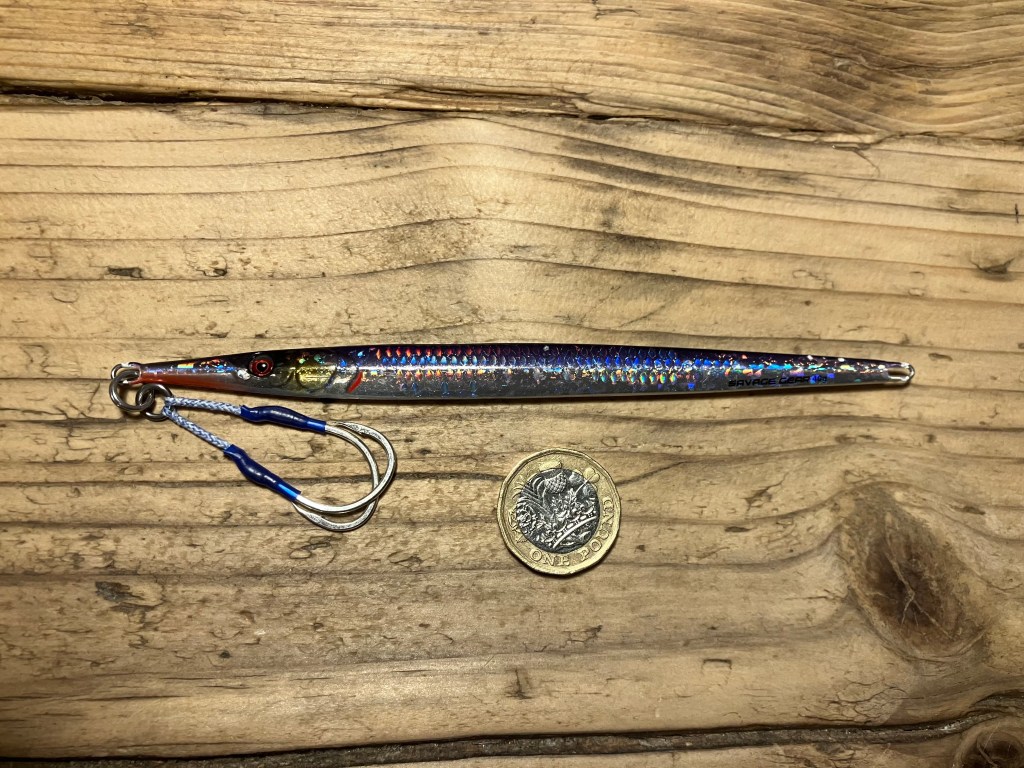
Savage Gear Needle Jig 40g

In my recent pollock fishing, I’ve had success with Savage Gear 40g needle jigs rigged with short cord double assists. These extra slim and lengthy jigs seemed to outperform other stubbier jigs, although the average size of the pollock has been very small (hopefully because of the location and not my skill).

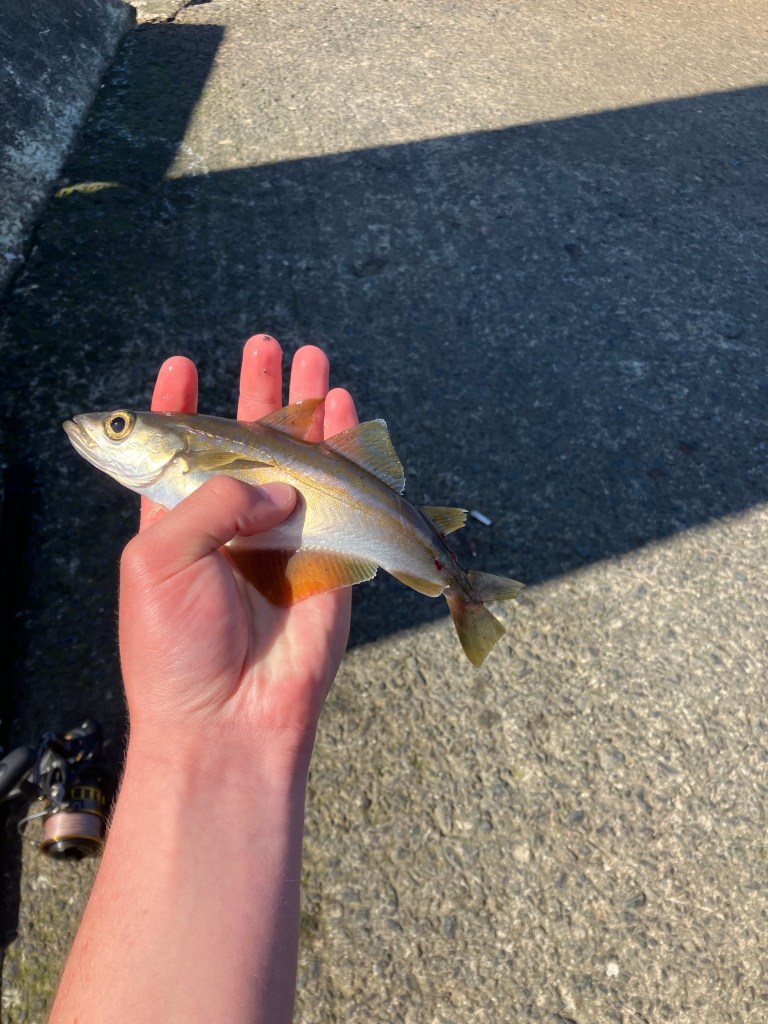
Pollock caught with Needle Jig

Initially I was hesitant to pair these lures with Vanfook Jigen Short Twin assists. I thought the cord was too short for this length of jig and that the fish wouldn’t be able to reach the hook, for example, if they struck from behind. But this hasn’t seemed to matter as I had a good hook up ratio, even when the fish have been only slightly bigger then the jig. Perhaps it’s to do with how aggressive the fish are behaving, or that attacks might be directed at the head of the lure or that the hooks stay closer to the jig when it’s falling. Whatever the reason is, I’m now confident that front double assists no matter how stubby, suit my more slow style of jigging. The assist hooks that I do myself, I try to make on the shorter side because of this.
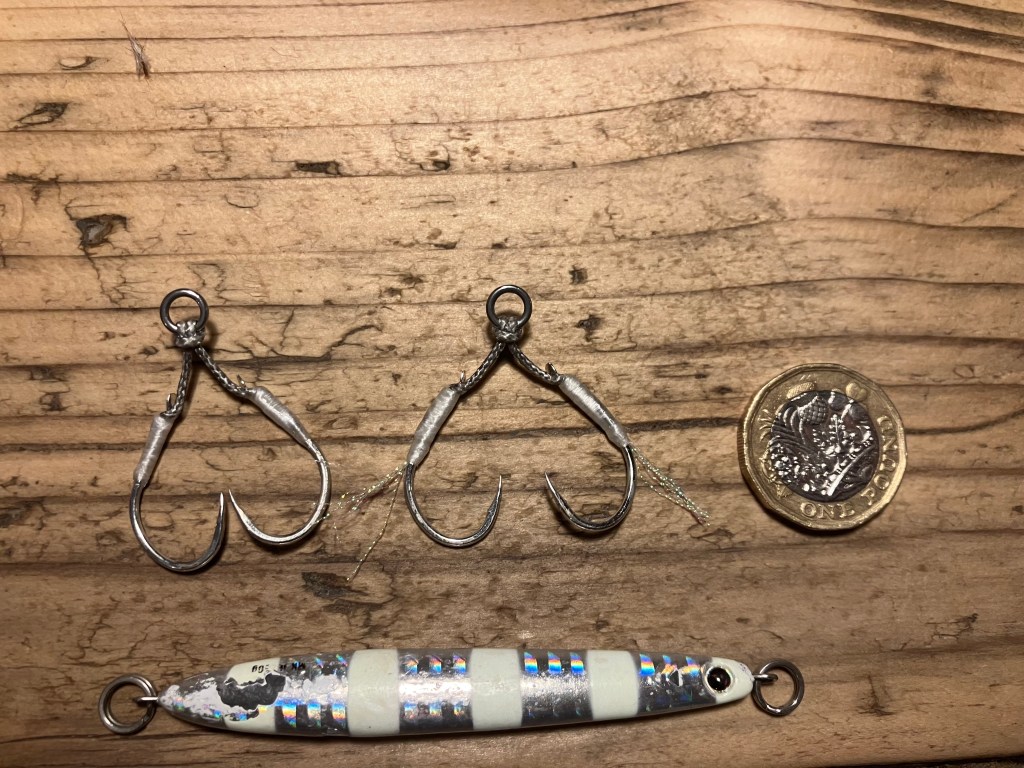
Homemade assist hooks beside 30g jig for reference

Of course it helps to use hooks of certain designs and sharpness but that’s a separate topic for another time.

https://www.instagram.com/sochfishing/

Thoughts on the Decoy CS-2 Plus Sinker

I have amassed a large collection of soft plastic lures over the years, of many sizes and colours. This is partly because they are cheaper then hard lures, but mostly it’s due to their huge versatility and options for customization. A single soft plastic can be rigged for effective use in most conditions and ground; no level of the water column is off limits.

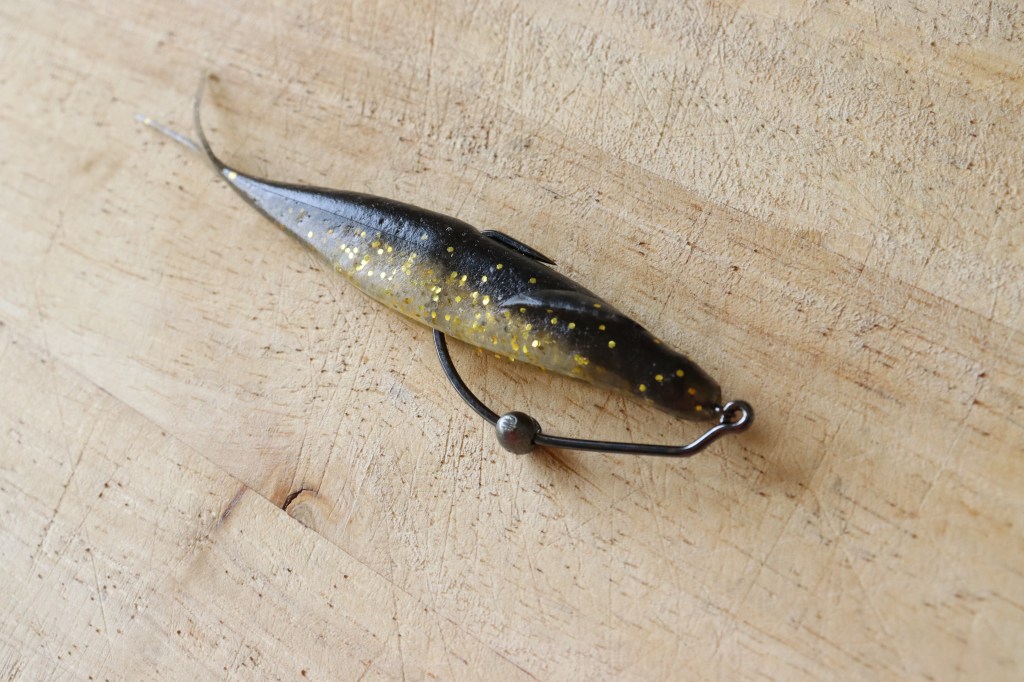
One product for customising soft plastics, that has caught my attention, is the Decoy CS-2 Plus Sinker. This is a unique system for weighting wacky or offset hooks, consisting of lead split shot style weights, designed with a wide enough mouth to fit onto the shank of a hook. They are sold in 0.6, 0.9 and 1.3 gram sizes – the size pictured being 0.9 gram. These light weight options provide a good balance between weightlessness and a bit of keel, to keep the soft plastic running straight.

These sinkers can be crimped with pliers onto any section of an offset or wacky hook, opening up a world of weight and size combinations that can’t be bought from manufacturers. Not only this, but depending on the position of the sinker, the movement of your soft plastic can be altered to suit different depths and retrieves.

I believe that the Plus Sinkers are best used on swimbait hooks, with screw locks, as you can remove the hook from the lure without the attached weight tearing the plastic. Also, there is then the option to attach the weight just under the hook eye.

Pictured below is the 5″ Deps Sakamata Shad on a 4/0 swimbait hook to demonstrate the options you get with the 0.9 gram Plus Sinker.

With the weight just under the hook eye, you can imitate the faster, nose down fall of a light jig head, meaning that this configuration is optimal in deeper water or when bottom bouncing.

With the weight in a rear position, the lure will slide backwards when paused, similar to the effect of the Decoy Back Switcher hook.

With the weight at the centre of the hook, the fall will be horizontal and therefore slower, suiting shallow water better.

One of the downsides of this system is the toxic lead construction, but this is unfortunately necessary as the sinker needs to be crushed onto the shank to stay put. The other is that they are difficult to remove from your hooks once crimped.

Aside from these points, these sinkers by Decoy offer a lot of utility and customisation for your soft lures, and therefore I can see myself using them a lot in the future.

https://www.instagram.com/sochfishing/

The scalpel of lure rigs

While I have only caught a couple of Ballan (and corkwing) wrasse in the few years that I’ve been sea fishing, I’m interested in chasing more of these fish in the coming summer months. The tricky, snaggy reefs, in which they live deep within, have always proved challenging for me to fish. Generally, I am more at home with fishing higher in the water column for other species, like bass. So far I’ve only caught my wrasse dropshotting small worm lures and Isome, but I’ve found this method fairly restrictive as I’ve felt forced to fish the margins of the weed or else get snagged.

A wrasse caught on a dropshot rig

Naturally, the plan for the summer is to focus on an offset hook system, set up to be as streamlined as possible, so it can punch through cover to the bottom every time. Also, precision is needed when flipping into promising gulleys and weed beds. Here, I could use a Cheb or Texas rig, but they tend to glide and pendulum on the fall, so I’m going to be trying to master the Jika rig.

It is usually composed of an offset hook, connected to a split ring with a skinny weight, but you can also attach the weight via a snap connector. The dropshot-style weight rivals the weed-penetrating power of much heavier bullet sinkers, meaning that this rig is more applicable to light setups. The characteristic advantage of the rig is that it sinks straight down upon entering the water and then the soft plastic can freely move. I intend to rig creature baits and curly tail grubs in this way, to mimic the crabs, lobsters and other creatures that are all food for big Ballans. As for retrieval, the general consensus is that this versatile rig can be worked in many ways, but I believe it will shine when shaken with the rod tip, whilst static on the bottom.

A Nories Escape Little Twin 4″ in ‘Light Green Pumpkin’

A Molix RA Grub Twin Tail

When I have access to the sea again this summer, I will report my experience with the rig on my Instagram

https://www.instagram.com/sochfishing/